Field guide · Robotics & embodied AI
Robotics and embodied AI: make one action repeatable first
The humanoid in the video folds laundry. Yours cannot put a block in a box without retuning. A robot is not one large model; body, sensors, control stack, policy, simulation and evaluation work together. Make one action repeat 100 times in the real world before talking about humanoids or generality.
- Fix one action, one object and one success test.
- Simulation speeds things up; it does not replace 100 real-world repeats.
- Record failures before talking about generalisation.
The full guide starts below. Use the tables for reference; you do not need to memorise them.
Take one concrete job: a arm picks a block and puts it in a box, succeeding twice out of three attempts. Get that working before touching a humanoid.
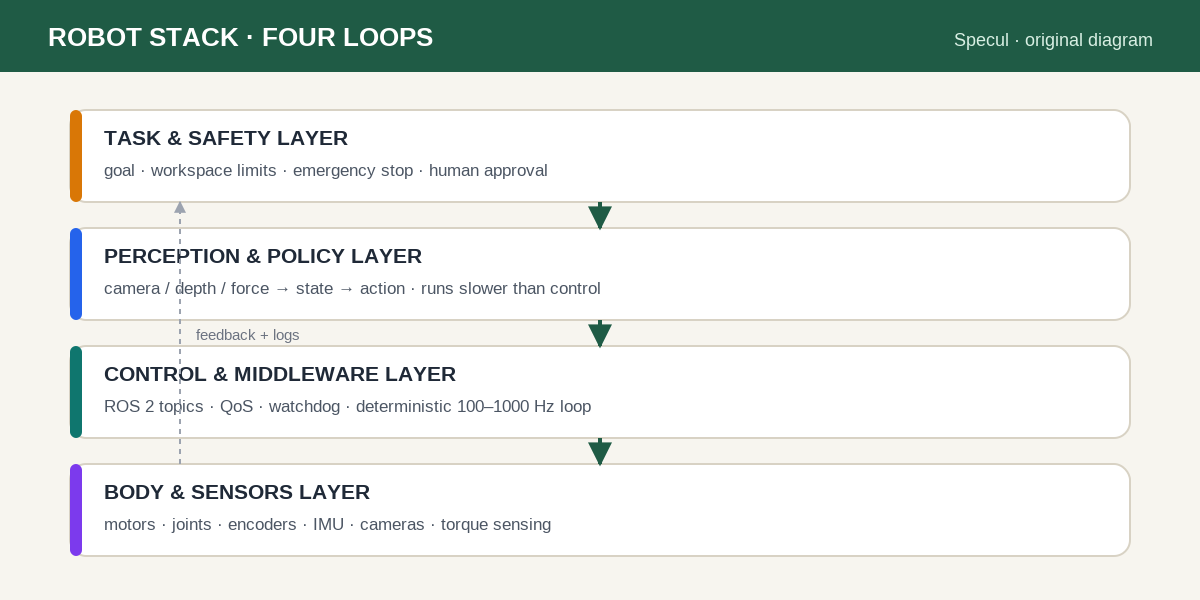
1 · Separate four layers instead of one “robot model”
The body and sensor layer answers “where am I, what is around me and how much force is at each joint”. The control and middleware layer sends actions on time and within safety limits. The perception and policy layer decides the next action from what is sensed. The task and safety layer decides whether the task should run at all, and when to stop.
A large model usually sits in the perception/policy layer, or above it in the task layer. It outputs intents, action chunks or coordinates — not motor current. Putting cloud inference directly into a 100–1000 Hz control loop makes latency and jitter break the system before intelligence matters.
A useful test: if a failure must trigger an immediate stop, the logic belongs in control/safety; if a failure can pause for a human decision, it can live in policy/task.
| Layer | Question | Typical components |
|---|---|---|
| Task & safety | What to do, when to stop, who approves | Task orchestration, permissions, e-stop, risk assessment |
| Perception & policy | What is sensed, what to do next | Vision/depth/force, VLA, imitation policies |
| Control & middleware | How to execute on time and stably | ROS 2, DDS, PLC, EtherCAT, watchdog |
| Body & sensors | What is physically possible | Joints, motors, encoders, cameras, IMUs, force sensors |
2 · Body: choose the task before the humanoid
A wheeled base, a fixed arm, a collaborative arm and a legged humanoid are four different engineering problems. A fixed arm makes precision, repeatability and fencing easiest. A wheeled base suits inspection and transport on flat floors. Legs suit steps and rubble, but control, energy and fall risk jump by an order of magnitude.
Write down four things before choosing a body: payload, reach, battery/duty cycle and the safety distance to people when something fails. Without these four, the form-factor debate is aesthetics.
A humanoid earns its keep in environments designed for humans — door handles, stairs, tools. The price is more degrees of freedom, harder control, a higher centre of gravity and worse fall consequences. Unless the task truly needs general operation in a human environment, a dedicated form is the safer first build.
3 · Sensors and timing: ask “when was this captured” before “what is in it”
A typical robot carries RGB and depth cameras, an IMU, joint encoders and force/torque sensors. Each stream has its own timestamp, rate and latency. Without time synchronisation, the fused state is wrong. A 30 fps camera already means a 33 ms sample interval, while the control loop may complete a cycle in 10 ms.
Do three things first: timestamp every stream against a shared clock; calibrate camera intrinsics, extrinsics and hand-eye geometry; treat dropped, stale and out-of-range data as first-class failures instead of asking the model to guess. Depth cameras fail on reflective, transparent and bright surfaces; force sensors saturate in collisions and assembly. Record these at collection time.
Do not accept a system on recognition accuracy alone. Check end-to-end latency (P50 / P95 / worst case), dropped-frame rate, drift after recalibration, and whether the system enters a safe state when a sensor fails.
4 · Control and middleware: real time means meeting every deadline, not running fast
ROS 2 provides publish/subscribe, services, actions, parameters, lifecycle and QoS. It is good for connecting perception, planning, logging and visualisation. But wrong QoS (for example a growing reliable queue), heavy work inside callbacks, or garbage collection and network jitter on the control path turn “real time” into a slogan.
The hard-real-time segment usually belongs to a PLC, motion controller or EtherCAT slave; ROS 2 handles orchestration and state publishing above it. The emergency stop must be an independent safety chain, not a Python process on the same general-purpose computer.
Minimum acceptance: a watchdog detects a stalled main loop; actuators go to a defined safe state when communication drops; logs can replay the command–state–action timeline. Without replay, failures are guessed.
5 · Models and policies: VLA is an interface, not magic
A VLA (vision–language–action) model connects images, instructions and action chunks. It is good at mapping instructions such as “put the red block left of the tray” to action sequences, but it does not guarantee physical feasibility, safety or generalisation to a new scene. Policy output must pass kinematic, collision and force-limit safety filters before it reaches the actuators.
Data is a more common bottleneck than the model. Real-robot collection is slow and expensive and rarely covers failures; simulation widens coverage but introduces rendering and physics gaps. Imitation suits fixed tasks with expert demonstrations; reinforcement learning suits settings where trial and error is cheap and simulation is trustworthy. Neither replaces on-site acceptance.
A pragmatic order: fixed task with a hand-coded baseline → add perception assistance → add a learned policy → keep safety filters and fallback. Do not jump straight to “end-to-end large model controls the whole machine”.
6 · Simulation and evaluation: prove it can fail before proving it can succeed
Isaac Sim, Gazebo and Webots can model scenes, sensors and physics. Their value is not a good-looking demo; it is repeatable failure under controlled conditions: lighting changes, occlusion, reflections, sensor noise, slipping objects, communication delay and e-stop triggers.
An evaluation table needs: success rate with confidence interval, mean and worst completion time, human takeovers, collisions and boundary violations, recovery time, and the environment plus log for each failure. A bare “95% success” without sample size, scenes and failure definition is not a result.
Passing simulation is only a ticket to the real machine. Real-machine acceptance is separate: speed and force limits, fencing, e-stop, human-presence detection, and what the actuator does when the model output goes out of bounds.
7 · Safety and compliance: standards are a floor, risk assessment is the start
Industrial robots are commonly assessed against the ISO 10218 series; collaborative settings also involve the force and speed limits in ISO/TS 15066. The applicable clauses, acceptance method and local legal requirements must be fixed on site by qualified safety people. This page does not replace a safety review or give a compliance conclusion.
Separate three protection layers in engineering: physical limits and e-stop on the body; speed, force and workspace limits in control; permissions and human confirmation in the task layer. If any layer can be bypassed, the system is not safe.
Manage change after launch: a new model, camera, gripper, floor or task can invalidate the original risk assessment. Re-run the restricted scenarios and e-stop tests for every change.
8 · A minimum path to deployment
- Write one task: input object, target location, success criterion and allowed failure modes.
- Build a hand-coded baseline: a fixed trajectory or teleoperation that proves the mechanics and sensors can do the task.
- Put time sync, calibration, dropped-frame and failure detection into collection and replay.
- Run a failure matrix in simulation, recording the environment and log for each failure.
- Move to the real machine with speed/force limits and independent fencing and e-stop; change one variable at a time.
- Include operators in acceptance: takeovers, recovery time, false positives and misses all count.
- Pass model output through a safety filter and define fallback on out-of-bounds, timeout and communication loss.
- Re-assess on change: any model, sensor, gripper, site or task change triggers the restricted scenarios again.
9 · Four common mistakes
- “Build a humanoid, then find a use”: form-first raises degrees of freedom, cost and fall risk at the same time.
- “The demo video is the capability”: it edits out failures, takeovers and setup, and cannot replace an evaluation table.
- “Let the large model drive the motors”: probabilistic output in a hard-real-time loop has no safe bound on latency or out-of-range actions.
- “Simulation passed, so it can ship”: simulation misses real friction, reflections, wear, human behaviour and the e-stop chain.
Sources and further reading
These links are for checking facts, licences and official scope. External pages may change; cite the original text and check date.
- ROS 2 DocumentationROS 2 publish/subscribe, QoS, lifecycle and real-time notes; the official docs define the current version.
- ROS 2 repositorySource and distribution entry point for checking middleware implementations and releases.
- NVIDIA Isaac Sim documentationOfficial notes on scenes, sensors and physics; not a substitute for real-machine safety proof.
- ISO 10218-1Entry point for industrial robot safety requirements; qualified people must confirm applicability.
- ISO/TS 15066Entry point for collaborative robot force and speed limits; further reading only.
- Learn · Robot middlewareSpecul’s concept page on robot middleware and the communication layer.
- Learn · Robot policiesConcept page on policies, imitation learning and deployment boundaries.
- Learn · Embodied intelligenceThe difference between embodied and text-only intelligence.
- Compute · selection pathHardware thresholds for bodies, edge compute and sensors.
- AI Directory · RoboticsAI Directory of robotics and embodied-AI sites; not a Specul review.
Next
If you get stuck while following it, go back to the matching route instead of rereading the whole guide.